


Blog
NEC Code Commercial Hand Dryer Compliance Guide


NEC code commercial hand dryer compliance is defined as meeting the electrical installation and accessible mounting standards required by the National Electrical Code and the Americans with Disabilities Act for motor-operated appliances in public restrooms. Contractors and facility managers who skip either set of requirements face failed inspections, costly rework, and potential civil liability. The NEC classifies commercial hand dryers under Article 422 as motor-operated appliances, which triggers specific rules for branch circuits, disconnecting means, and GFCI protection. ADA Standard 307.2 adds a parallel layer of physical requirements covering mounting height, protrusion depth, activation force, and clear floor space. Understanding both frameworks together is the only way to pass inspection on the first attempt.
What are the NEC electrical requirements for commercial hand dryers?
Commercial hand dryers are motor-operated appliances under NEC Article 422, which means they fall under a specialized set of rules that modify the general motor requirements in Article 430. This distinction matters because Article 422 permits certain simplifications, including the use of a lockable circuit breaker as the sole disconnecting means, that Article 430 alone would not allow. Knowing which article governs your installation prevents both under-compliance and unnecessary over-engineering.
Branch circuit sizing and wiring gauge
Commercial hand dryers typically require dedicated branch circuits rated at 15 or 20 amps, sized to the nameplate rating of the specific unit. Standard practice for a 20A circuit is 10 AWG copper conductors, though you must always verify against the manufacturer’s installation instructions and NEC ampacity tables. A dedicated circuit prevents nuisance tripping and protects the dryer’s motor from voltage fluctuations caused by shared loads. Never share a hand dryer circuit with lighting, outlets, or other restroom equipment.
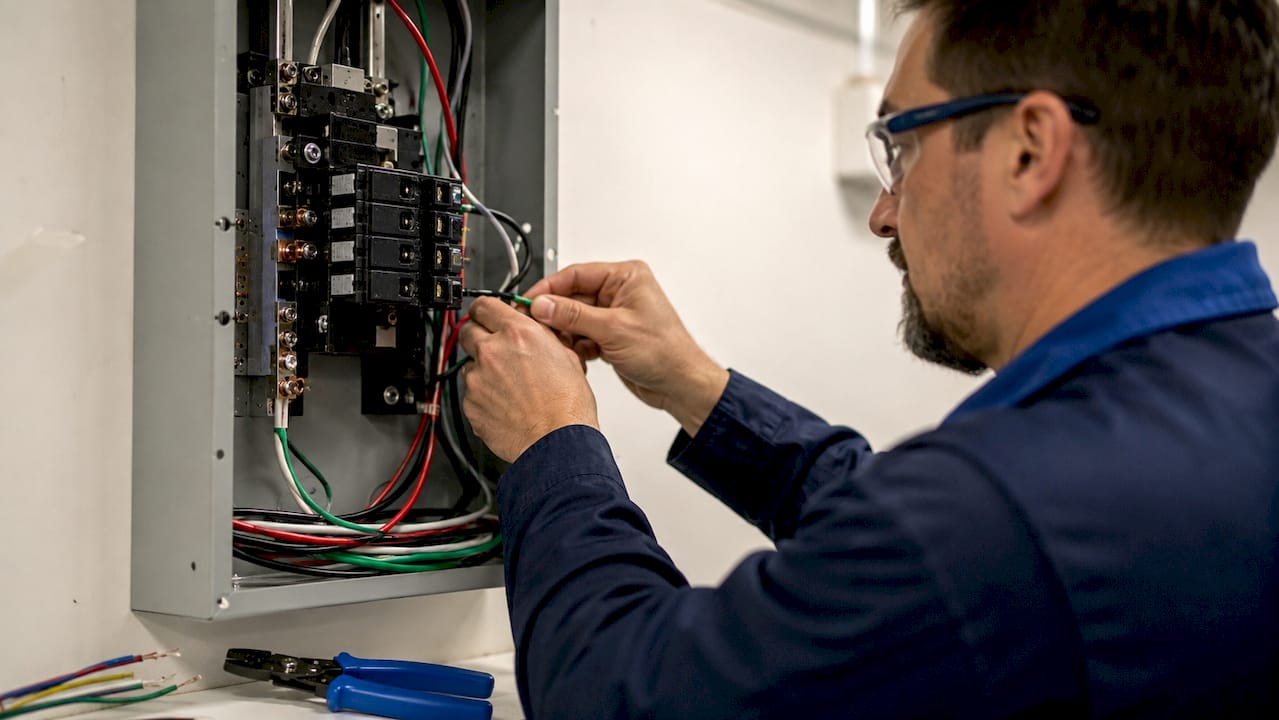
For 240V units, a 2-pole breaker is required. The wiring must be run in conduit sized per NEC Chapter 9 fill tables, and all connections must be made in accessible junction boxes. Verify the conduit type is appropriate for the environment, since restrooms are wet locations under NEC definitions.
Disconnecting means: lockable breaker vs. local switch
One of the most misunderstood points in electric hand dryer standards is the disconnecting means requirement. NEC 422.31© permits a lockable circuit breaker in the panelboard to serve as the disconnecting means, eliminating the need for a separate local disconnect switch within sight of the dryer. The breaker must be capable of being locked in the open position using a lockout device that complies with NEC 110.25. This provision significantly reduces installation complexity and cost for contractors working in retrofit environments where running conduit to a local switch is impractical.
Label the panel clearly. A laminated tag on the breaker identifying the specific dryer circuit is a simple step that prevents accidental re-energization during service and satisfies most Authority Having Jurisdiction (AHJ) inspectors.
GFCI protection requirements
NEC 210.8(A)(10) mandates GFCI protection for all laundry area receptacles, and the 2023 NEC update extended this requirement to 240V dryer circuits using 2-pole GFCI breakers. This means commercial hand dryer circuits in restrooms and laundry-adjacent spaces now require GFCI protection regardless of voltage. A tripped GFCI breaker in a busy public restroom is an operational inconvenience, but an unprotected circuit in a wet location is a safety and code violation.
Pro Tip: Specify a 2-pole GFCI breaker at the time of rough-in. Retrofitting GFCI protection after the panel is energized and walls are closed costs significantly more than installing it correctly from the start.
- Dedicated branch circuit: 15A or 20A per nameplate rating
- Wiring: 10 AWG copper minimum for 20A circuits
- 240V units: 2-pole breaker required
- Disconnecting means: lockable breaker per NEC 422.31© is code compliant
- GFCI: required per NEC 210.8(A)(10) for all laundry and restroom circuits
- Conduit: sized per NEC Chapter 9 fill tables, appropriate for wet locations
What ADA requirements affect mounting hand dryers in commercial spaces?
ADA compliance for hand dryers is governed by the ADA Standards for Accessible Design, with Section 307.2 being the critical reference for protrusion limits and Section 308 covering reach ranges. These standards apply to any public or commercial restroom, and violations carry civil penalties and exposure to ADA lawsuits. The physical installation requirements are just as binding as the electrical ones.
Key ADA mounting specifications
The table below summarizes the primary ADA factors that affect hand dryer installation in commercial restrooms.
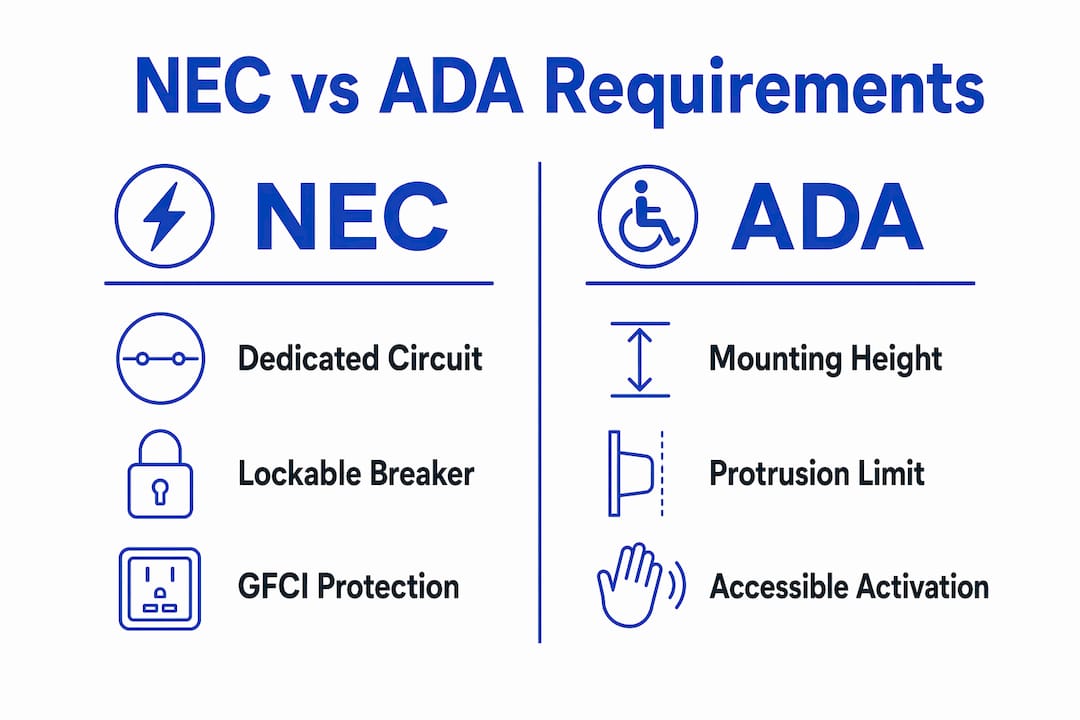
| ADA Factor | Requirement | Common Failure |
|---|---|---|
| Sensor/activation height | Maximum 48 inches from finished floor (forward reach) | Mounting too high for wheelchair users |
| Protrusion into path | Maximum 4 inches between 27 and 80 inches height | Exceeding 4 inches with surface-mount hardware |
| Clear floor space | Minimum 30 x 48 inches unobstructed in front of unit | Trash cans or fixtures blocking access zone |
| Activation force | Less than 5 pounds | Push-button models requiring excessive force |
| Activation type | Touchless sensor preferred | Manual push-button models on older installations |
The 4-inch protrusion limit between 27 and 80 inches above the finished floor is the most frequently failed ADA requirement during inspections. Many manufacturers list hand dryer depth excluding mounting hardware, so the installed unit can easily exceed 4 inches once the wall plate and fasteners are added. This is not a minor technicality. An inspector measuring 4.5 inches of protrusion will write a deficiency regardless of the unit’s listed specifications.
Surface-mounted vs. recessed installations
Surface-mounted hand dryers are faster to install but carry a higher risk of protrusion violations. Recessed models, or units designed with a shallow profile like the Excel Dryer ThinAir, are engineered to stay within the 4-inch limit without requiring a recess kit. The recessed installation guide from HandDryerUSA details how wall depth, blocking, and mounting hardware interact to affect final protrusion measurements. If your wall construction does not allow a full recess, a low-profile surface-mount unit is the safer choice.
Touchless sensor hand dryers satisfy the ADA activation force requirement of less than 5 pounds and the one-hand operation standard without any additional modification. Push-button or lever-activated models require careful review to confirm they meet the force threshold. For new installations, specifying a touchless unit eliminates this compliance variable entirely.
- Mount sensor activation point at or below 48 inches from finished floor
- Confirm total installed protrusion including mounting plate does not exceed 4 inches
- Provide a clear, unobstructed 30 x 48-inch floor space in front of the unit
- Specify touchless sensor activation to meet force and usability requirements
- Use recessed or low-profile models when wall depth allows
Pro Tip: Before ordering a unit, request the manufacturer’s full installed depth specification, not just the product depth. Add the thickness of the mounting plate and any wall anchors to get the true protrusion measurement.
How do NEC and ADA requirements intersect in hand dryer installations?
NEC electrical requirements and ADA mounting requirements operate on parallel tracks, but they intersect at the physical installation point. A hand dryer that is wired correctly but mounted too high fails ADA. A unit mounted at the correct height but without GFCI protection fails NEC. Passing inspection requires satisfying both codes simultaneously, and the coordination between your electrician and your installer is where most projects succeed or fail.
Here is the sequence that keeps both compliance tracks aligned:
- Confirm rough-in location before electrical work begins. The electrical rough-in must place the junction box at the correct height and horizontal position to support ADA-compliant mounting. Moving a box after drywall is installed adds cost and delays.
- Verify wall depth for recessed units during framing. If you are specifying a recessed model, confirm wall cavity depth with the framing contractor before insulation and drywall close the opening. A restroom inspection checklist from HandDryerUSA identifies this coordination point as a frequent source of rework.
- Coordinate disconnect placement with protrusion compliance. The lockable breaker serving as the disconnecting means must be in the panelboard, not on the wall near the dryer. This actually helps ADA compliance because it eliminates a wall-mounted switch that could itself create a protrusion or obstruction issue.
- Document measurements before closing walls. Record the junction box height, conduit routing, and breaker assignment in the project file. This documentation supports the AHJ inspection and provides a reference for future service calls.
- Conduct a pre-inspection walkthrough with both the electrician and the installer present. Measure protrusion, confirm sensor height, verify clear floor space, and test GFCI function before calling for inspection. Catching a 4.5-inch protrusion before the inspector arrives is far less costly than a failed inspection and re-inspection fee.
Local AHJ variance is real. Some jurisdictions adopt the 2023 NEC; others are still on the 2020 or 2017 edition. Confirm which edition your jurisdiction has adopted before finalizing your compliance checklist. The same applies to local amendments to ADA standards. Always consult the manufacturer’s installation instructions as a baseline, since they are written to the most current applicable standards and provide a defensible starting point with the AHJ.
What are best practices and common pitfalls in achieving compliance?
The most preventable compliance failures share a common cause: assumptions made during specification that are not verified during installation. The following practices eliminate the most common sources of failed inspections.
- Measure total installed depth before purchase. The installed protrusion including mounting hardware is what the inspector measures, not the product spec sheet depth. Add 0.5 to 1 inch for mounting plates when estimating.
- Use lockable breakers with clear panel labeling. A lockable breaker satisfies NEC 422.31© and eliminates the cost of a local disconnect switch. Label the breaker with the circuit location and dryer model for future service reference.
- Install GFCI protection at the panel. A 2-pole GFCI breaker covers the full circuit and is the cleanest solution for 240V units. For 120V units, a GFCI breaker or GFCI outlet upstream of the dryer connection satisfies the requirement.
- Confirm clear floor space is unobstructed. The 30 x 48-inch zone in front of the dryer must remain clear of trash receptacles, paper towel dispensers, and door swing paths. Plan the full restroom layout before finalizing dryer placement.
- Review hand dryer placement relative to traffic flow. Units positioned near doorways or in narrow corridors create both ADA protrusion violations and traffic congestion. Position dryers so the clear floor space does not overlap with primary circulation paths.
- Cross-reference ADA restroom requirements for the full installation. Hand dryers are one element in a broader accessible restroom design. Reviewing ADA restroom requirements for all fixtures together prevents conflicts between individual compliant elements.
Pro Tip: Conduct a mock installation using the actual mounting hardware before the dryer arrives on site. Attach the wall plate, measure protrusion, and confirm sensor height. This takes 20 minutes and prevents a failed inspection.
Key takeaways
NEC code commercial hand dryer compliance requires a dedicated branch circuit with GFCI protection, a lockable breaker as the disconnecting means, and ADA-compliant mounting that keeps protrusion under 4 inches and sensor height at or below 48 inches.
| Point | Details |
|---|---|
| NEC Article 422 classification | Hand dryers are motor-operated appliances requiring dedicated circuits and specific disconnecting means. |
| Lockable breaker as disconnect | NEC 422.31© permits a lockable panelboard breaker in place of a local disconnect switch. |
| GFCI protection required | NEC 210.8(A)(10) mandates GFCI on all restroom and laundry circuits, including 240V dryer circuits. |
| ADA protrusion limit | Total installed depth including mounting hardware must not exceed 4 inches between 27 and 80 inches height. |
| Coordinate early | Aligning electrical rough-in with ADA mounting specs during framing prevents costly rework at inspection. |
Why early coordination is the only compliance strategy that works
From HandDryerUSA’s perspective, the contractors and facility managers who pass inspection on the first attempt share one habit: they treat NEC and ADA compliance as a single planning exercise, not two separate checklists reviewed at different stages of the project. The electrical rough-in and the physical mounting spec must be confirmed together before a single wire is pulled or a single hole is cut.
The most expensive compliance failures we see are not caused by ignorance of the code. They are caused by the electrician and the installer working from separate sets of assumptions. The electrician places the junction box at a convenient height. The installer mounts the dryer where the box is. Nobody measures total protrusion including the mounting plate. The inspector arrives and finds 5 inches of protrusion on a unit that the manufacturer lists as 3.5 inches deep. That is a failed inspection, a re-inspection fee, and potentially a new unit if the wall cannot accommodate a recess.
The fix is straightforward. Request the full installed depth specification from the manufacturer before you specify the unit. Confirm GFCI and lockable breaker requirements with your electrician before rough-in. Walk the restroom layout with both the electrician and the installer before framing closes. These steps cost an hour of coordination time. Skipping them costs days of rework.
— HandDryerUSA
Find NEC and ADA compliant hand dryers at HandDryerUSA
HandDryerUSA stocks commercial hand dryers from Excel Dryer, Dyson, World Dryer, ASI, Bobrick, Saniflow, and Palmer Fixture, all selected to meet current NEC and ADA installation standards. Whether you need a low-profile surface-mount unit that stays within the 4-inch protrusion limit or a recessed model for a tight wall cavity, the catalog covers the full range of commercial applications.

Browse the full selection of ADA-compliant touchless dryers to find units with confirmed installed depth specifications, touchless sensor activation, and manufacturer wiring guides that align with NEC Article 422 requirements. For installations where protrusion is the primary constraint, the recessed and vertical models section includes hands-in dryers engineered to meet ADA protrusion limits without custom wall work.
FAQ
What NEC article covers commercial hand dryers?
Commercial hand dryers are classified as motor-operated appliances under NEC Article 422, which governs branch circuit sizing, disconnecting means, and GFCI protection requirements for these units.
Do commercial hand dryers need a dedicated circuit?
Yes. Commercial hand dryers require a dedicated branch circuit rated at 15 or 20 amps based on the unit’s nameplate rating, with wiring sized per NEC ampacity tables.
Is a local disconnect switch required for a hand dryer?
No. NEC 422.31© permits a lockable circuit breaker in the panelboard to serve as the disconnecting means, eliminating the need for a separate local switch within sight of the dryer.
What is the ADA protrusion limit for hand dryers?
ADA Standard 307.2 limits protrusion to 4 inches into circulation paths for any object mounted between 27 and 80 inches above the finished floor. This measurement includes mounting hardware, not just the dryer body.
Are hand dryers NEC compliant if they use a standard outlet?
No. Hardwired installation on a dedicated circuit is required for commercial hand dryers. Plug-in connections to standard outlets do not meet NEC Article 422 requirements for motor-operated appliances in commercial applications.